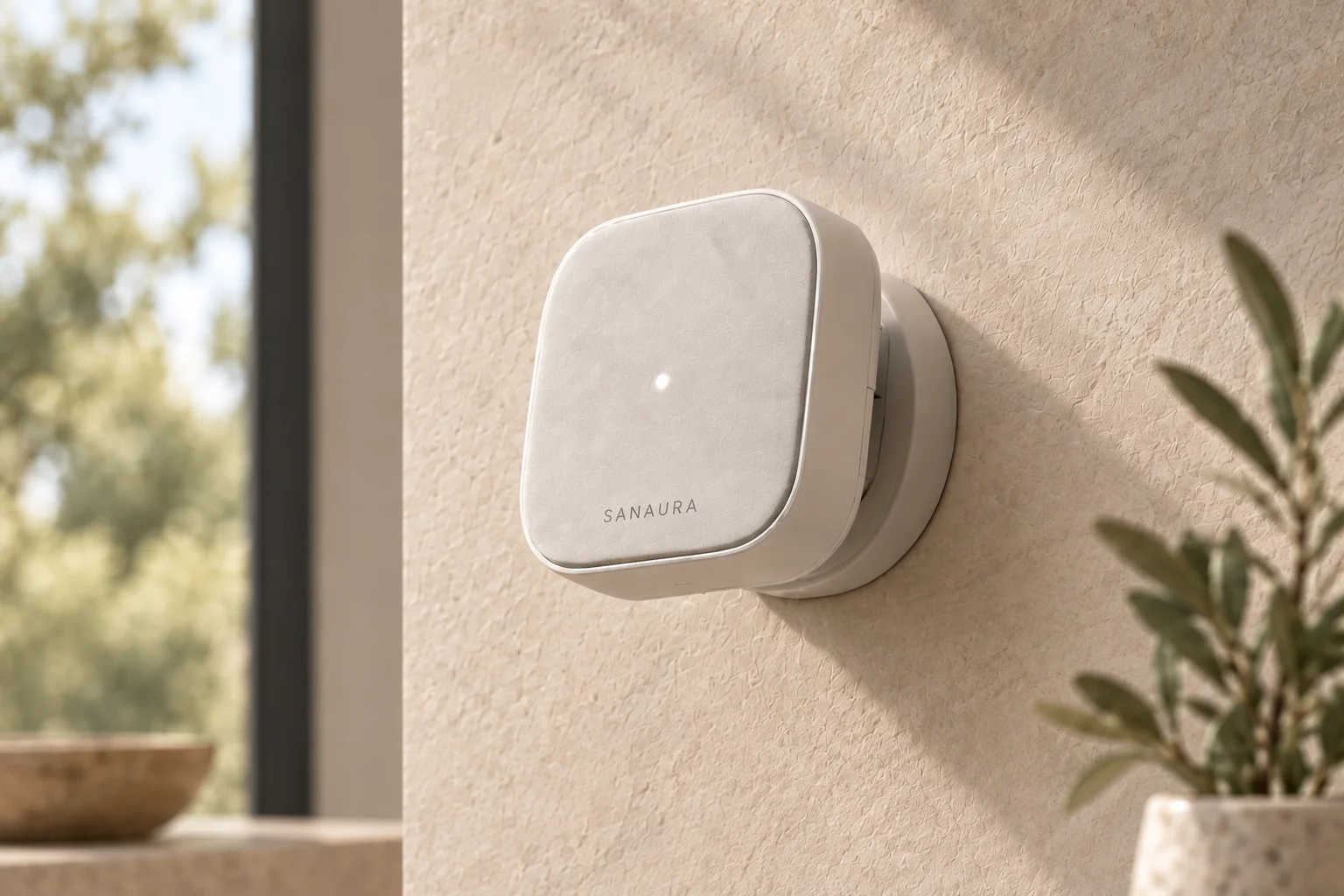
Sanaura technology
A new sense
of home.
Radar reflections. Room context.
No optical image.
60 GHz radar. A spatial intelligence direction.
A different way to understand space
A home doesn’t need
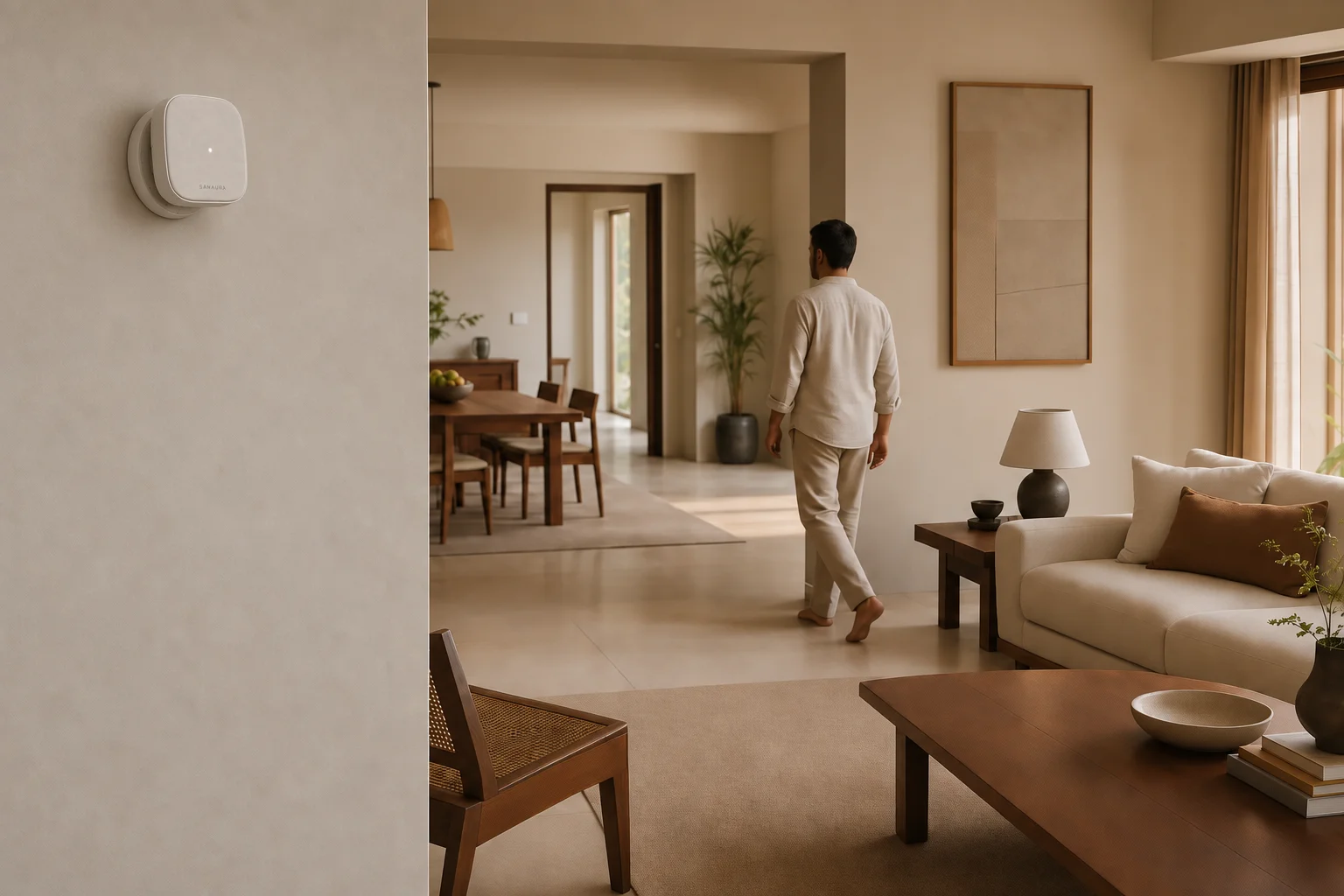
a camera in every room.
It needs a little understanding.
Sanaura S1 is being developed to sense presence and movement through radar reflections. The ambition: useful room context, without an optical image of the life inside.
See how it works01 / From signal to meaning
The room, translated.
One arrival. Six layers of understanding.
Explore how a reflection could become a response.
Use Left and Right arrows to move between stages, then Enter or Space to select. Home and End move to the first and last stages.


01 / Radar emission
A signal enters the room.
A 60 GHz signal is directed into the room. Our illustrative story begins with someone arriving.
Illustrative sequence · Not live sensor outputConcept hardware representation
What this illustration does—and does not—show
The outgoing paths are schematic. They do not describe a measured beam or a guaranteed coverage area.
The scene, points, paths, floor grid and zones explain a development direction. They are not recorded sensor output, a reconstructed room, measured coverage or validated tracking. No available automation integration is demonstrated.
02 / A considered kind of sensing
Presence.
Not pictures.
The goal isn’t to collect every detail. It is to find the spatial information that helps a home respond thoughtfully.
 Optical information
A picture of the room.
Optical images can contain visual identity, clothing and environmental detail.
A sense of what is happening.
Sanaura aims to interpret presence, approximate movement and configured zones.
03 / Quietly architectural
Small presence.
Considered placement.
A sensor belongs to its room. Its position, orientation and surroundings all shape what it can observe.
Mount with intention.Horizontal direction is set during installation, with the room and its entry points in mind.
Aim with tilt.The mounting concept calls for vertical tilt only, a clean connected mount and an unobstructed front radar window.
The room sets the conditions.
Furniture, doorways and room boundaries affect observation. There is no universal coverage circle—and no validated coverage figure is presented here.
The mechanism is still a concept.
Secure locking, long-term tilt stability and concealed cabling are engineering requirements, not verified properties of the rendered enclosure.
Placement studies & hardware boundaries
Wall and corner placement change observation direction. Ceiling-oriented installation remains a separate exploration requiring workflow-specific validation. No mounting option is represented as supporting every capability. Radar should not be assumed to pass reliably through every wall or object.
The enclosure shown is a provisional design used to communicate form, placement and sensing behaviour. Final engineering may change after antenna, thermal, structural and manufacturing validation.
This concept is not CAD, an installation guide or an engineering-ready enclosure.
04 / The engineering beneath it
Real physics.
Ongoing engineering.
Our current radar-development platform is the TI IWR6843AOP. Hardware is the starting point. Reliable spatial interpretation is the work ahead.
- 01
Radio reflections
The physical starting point: signals interacting with the person, objects and room.
- 02
Signal processing
Turning selected returns into useful spatial observations, with uncertainty and environmental constraints.
- 03
Spatial interpretation
Exploring how observations over time may describe presence, movement and meaningful room events.
Development status & research limitations
This is a development architecture, not a frozen production specification. Spatial tracking, zones and event interpretation require validation across rooms, placements and real-world conditions.
A basic motion event can indicate that something changed. Spatial interpretation explores additional context about where and how it changed. This does not imply every conventional motion sensor has the same limitations, or that Sanaura has validated every capability.
Future responses depend on additional platform and integration work. Safety, wellness and security ideas are not validated outcomes of this demonstration.
The next chapter